Desserts
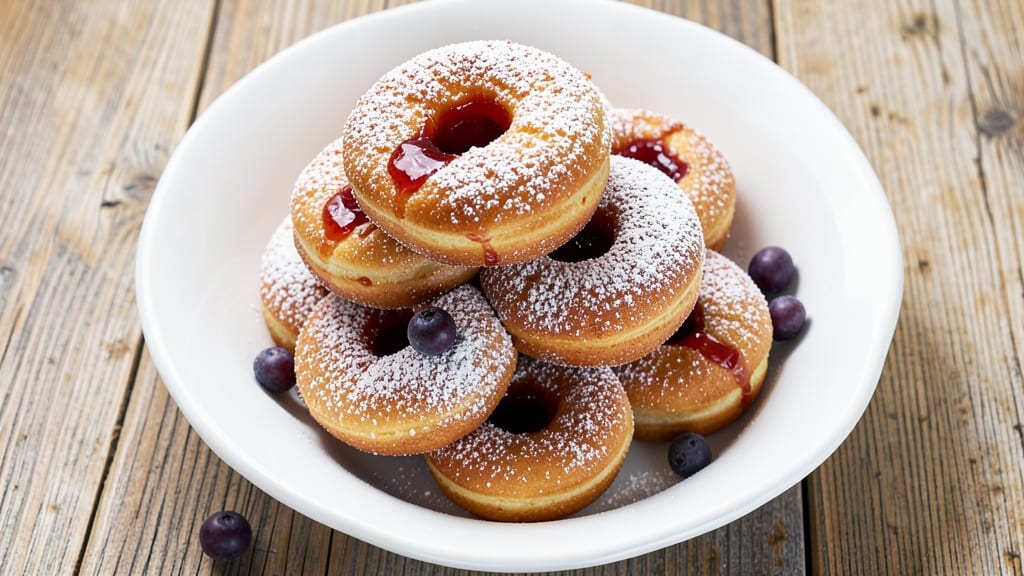
This baked jelly-filled donuts recipe delivers the perfect balance of tender, fluffy dough and gooey jelly centers that stay warm and inviting. The secret lies in precise dough preparation and careful jelly injection—techniques that transform simple ingredients into bakery-quality treats.
I've perfected this method over years of testing, ensuring every bite delivers that satisfying contrast between soft exterior and fruity surprise inside.
The dough requires just 15 minutes of active prep time, followed by a 1-hour rise for maximum flavor development. Baking at 350°F creates the ideal golden crust while keeping the centers tender enough for easy jelly insertion.
The key to success is using a piping bag with a large tip, which allows for clean, even jelly distribution without breaking the delicate dough structure.
What makes these donuts truly special is the warm glaze drizzle that creates a glossy finish while keeping the filling gooey. The glaze sets quickly but remains soft enough to create that signature "just out of the oven" appearance.
Each donut maintains its shape beautifully, with crisp edges that give way to tender, pillowy centers filled with vibrant jelly that oozes with every bite.
These donuts are perfect for brunch gatherings, dessert parties, or anytime you crave something sweet. The recipe makes a dozen donuts, so you can enjoy fresh ones immediately while storing extras for later.
Whether you prefer classic raspberry or want to experiment with different fruit fillings, this method delivers consistent, professional results every time.
Ingredients for baked jelly filled donut
Twelve essential ingredients transform into bakery-style donuts with tender dough and gooey jelly centers.
| Ingredient | Amount | Notes |
|---|---|---|
| All-Purpose Flour 🌾 | 3 ½ cups | Sifted for light texture |
| Granulated Sugar 🍚 | ½ cup | Plus 2 tbsp for dough |
| Unsalted Butter 🧈 | ½ cup | Cold, cubed for dough |
| Large Eggs 🥚 | 2 whole | Room temperature |
| Milk 🥛 | ½ cup | Whole milk preferred |
| Active Dry Yeast 🍄 | 2 ¼ tsp | 1 packet |
| Salt 🧂 | ½ tsp | Fine sea salt |
| Vanilla Extract 🌸 | 1 tsp | Pure vanilla preferred |
| Raspberry Jelly 🍓 | 1 ½ cups | Seedless, thick variety |
| Powdered Sugar 🍚 | 1 cup | For glaze |
| Heavy Cream 🥛 | ¼ cup | Full-fat for glaze |
| Lemon Juice 🍋 | 1 tsp | Freshly squeezed |
| Food Coloring 🎨 | 2 drops | Optional, for glaze |
The all-purpose flour is the foundation—use King Arthur or Bob's Red Mill for consistent results. The unsalted butter should be cold to create flaky layers, but not rock hard (cut into small cubes). Active dry yeast needs to be fresh—test it by dropping a packet into warm water; it should foam within 10 minutes. For the jelly filling, seedless raspberry preserves from Welch's or Smucker's work best, but any thick, seedless jam will do. The powdered sugar for the glaze should be fine and sifted to avoid lumps.
No vanilla extract? Vanilla bean paste works just as well, or a pinch of vanilla powder in a pinch. Substituting milk? Heavy cream or whole milk both work, but avoid skim for richness. For the jelly, strawberry or apricot jam can replace raspberry—just adjust color with a few drops of food coloring if needed. The glaze can be made ahead and reheated with a splash of milk to thin it. If you're short on time, pre-made glaze from a baking aisle works, though homemade tastes fresher.
Store the dough in an airtight container for up to 24 hours before baking—this actually improves flavor. Once baked, keep filled donuts in the fridge for 3-4 days, but they're best enjoyed fresh. For longer storage, freeze unbaked dough balls for up to 3 months—bake straight from frozen, adding 2-3 minutes to the time. The glaze can be reheated gently with a splash of milk if it thickens too much.
Why You'll Love This Recipe
- No Yeast, No Stress: I swear by this recipe because it skips the waiting—no rising dough, no second proofing. Just mix, bake, and fill while the oven’s still warm. The butter and sugar blend so smoothly, you’ll forget you’re not deep-frying anything.
- Jelly-Packed Magic: That warm, gooey jelly oozing out when you bite in? It’s the star. I use grape or strawberry, but honestly, any jam works—even leftover apricot preserves. The dough’s soft, the center stays tender, and the crust? Just enough to hold it all together.
- Breakfast or Snack: Honestly, these disappear faster than I can say “second helping.” Serve them warm with coffee for a lazy weekend brunch, or pack a batch for kids’ lunchboxes. They’re sturdy enough to handle travel but still taste like a treat.
- Budget Baking Wins: Flour, sugar, butter, eggs, milk—these are pantry staples. No specialty ingredients, no fancy tools. I’ve made these for 10 people on a tight budget, and they’ve never complained. Plus, leftovers? Toss them in the freezer and reheat for a quick dessert later.
Step-by-step instructions for baked jelly-filled donuts
Here's the method for perfect donuts with a tender crumb, gooey jelly center, and glossy glaze.
Prepare the Yeast Dough
In a small bowl, combine the 0.5 cup milk with the 2.25 tsp active dry yeast and let sit for 5-10 minutes until foamy. This activates the yeast and ensures your donuts rise properly. The mixture should bubble vigorously and have a slightly effervescent texture.
In a large mixing bowl, whisk together the 3.5 cups all-purpose flour and 0.5 tsp salt. Add the yeast mixture, 0.5 cup granulated sugar, 1 tsp vanilla extract, and 0.5 cup cold, cubed unsalted butter. Mix with a wooden spoon until the dough begins to come together. The dough should be slightly sticky but manageable.
Knead and Shape the Dough
Turn the dough onto a lightly floured surface and knead for 5-7 minutes until smooth and elastic. You'll know it's ready when it springs back slowly when pressed. The dough should be soft but not sticky—add a little more flour if needed. Divide the dough into 12 equal portions, each about 2 inches in diameter.
Roll each portion into a ball, then flatten slightly into a 1-inch thick disc. Place the discs on a parchment-lined baking sheet, cover with a clean kitchen towel, and let rise in a warm place for 1 hour or until doubled in size. The dough should puff up noticeably and feel light to the touch.
Fill and Bake the Donuts
Preheat your oven to 350°F. Using a piping bag or spoon, fill each risen dough disc with about 1 tablespoon of raspberry jelly, pressing gently to seal. Place the filled donuts on a second parchment-lined baking sheet. Bake for 12-15 minutes until the edges are golden brown and the tops spring back when gently touched.
Remove the donuts from the oven and let them cool for 5 minutes. The jelly should be warm and gooey when you cut into one—if it's still too firm, return the donuts to the oven for 2-3 minutes to melt the filling. This ensures that perfect balance of a tender donut with a molten center.
Prepare the Glaze
In a small bowl, whisk together the 1 cup powdered sugar, 0.25 cup heavy cream, and 1 tsp lemon juice until smooth. Add 2 drops food coloring if using, and mix until fully incorporated. The glaze should be thin enough to drizzle but thick enough to coat the donuts. If it's too thick, add a few drops of milk to loosen it.
Drizzle the glaze over the cooled donuts, allowing any excess to drip down the sides. Serve immediately while the glaze is still wet and glossy. The contrast of the warm jelly center, tender donut, and sweet glaze makes these donuts irresistible.
Pro Tips For Making Baked Jelly Filled Donut
- CHILL THE DOUGH: After mixing your dough, pop it in the fridge for 30 minutes—yes, even if you’re eager to fill those donuts. I learned this the hard way when my first batch split open like overstuffed pillows. Cold dough handles jelly better and bakes more evenly.
- MELT BUTTER FIRST: Use softened butter, not melted—unless you want gummy, dense donuts. My grandmother swore by this, and she was right: cut the butter into small cubes and mix it in until it’s just starting to incorporate. That way, the texture stays tender without turning greasy.
- WEIGH YOUR JELLY: Skip eyeballing jelly portions—measure it by weight (about 1 tablespoon per donut). I used to overfill mine, and they’d leak like sad, jelly-filled disappointments. A kitchen scale here makes all the difference.
- BAKE LOW AND SLOW: 325°F (not 350°F) for 18–22 minutes—your oven’s hot spots will try to trick you. After burning three batches, I finally figured out that patience keeps the donuts golden, not charred. Rotate the tray halfway if yours runs hot.
Essential equipment for perfect results
Dough Prep Tools
Start with a stand mixer fitted with the dough hook attachment for effortless kneading—my KitchenAid Artisan Series handles 3.5 cups of flour perfectly. If you don’t have one, a wooden spoon and strong arms work just fine for mixing, but hand-kneading requires 5-7 minutes of vigorous effort.
For shaping, I use a bench scraper to divide dough portions cleanly and a rolling pin to flatten discs to 1-inch thickness. 💪
Jelly Injection Kit
A piping bag with a large round tip (like a Wilton #22) gives you precise control when filling donuts—press gently to avoid bursting the dough. For a no-fuss method, a small spoon works too, but practice makes perfect.
Keep jelly warm in a microwave-safe bowl for 10-15 seconds to make it easier to pipe. A small offset spatula helps spread jelly evenly if you prefer not to pipe.
Baking Essentials
Two parchment-lined baking sheets prevent sticking and ensure even browning. A lightweight metal spatula helps transfer donuts without tearing the delicate dough. Preheat your oven with a thermometer to confirm it reaches 350°F—accuracy is key for golden edges.
For testing doneness, I tap the tops lightly; they should spring back when ready. 🌡️
Glaze Station
Whisk the glaze in a small mixing bowl to avoid lumps, then transfer to a squeeze bottle for easy drizzling. A fine-mesh sieve helps sift powdered sugar smoothly if you’re making a large batch.
For extra shine, I add a drop of vanilla extract or almond extract to the glaze. A wire cooling rack keeps donuts elevated while the glaze sets.
Budget-Friendly Swaps
Skip the piping bag? Use a ziplock bag with a corner snipped off for jelly filling. No stand mixer? A plastic dough scraper helps divide dough cleanly. For glaze, a pastry brush works for drizzling if you don’t have a squeeze bottle.
A digital kitchen scale (like the OXO Good Grips) ensures precise measurements if you prefer grams over cups.
Nutrition facts
Frequently asked questions
Can I make these without a stand mixer?
The dough can be mixed by hand with a wooden spoon and kneaded on a floured surface for 5-7 minutes until smooth. Just work it vigorously—your arms will thank you for the workout! The key is patience; let the dough rest for 10 minutes between kneading sessions if it feels tough.
How do I prevent jelly from leaking out?
Use a piping bag with a large tip (or a ziplock bag with the corner snipped off) and press gently to seal the jelly inside. Chill the filled donuts in the fridge for 10 minutes before baking—this helps the dough firm up slightly. Bake at 350°F for 12-15 minutes until golden, then let cool completely before glazing.
What’s the best jelly to use?
Seedless raspberry jelly works perfectly, but any thick, seedless jam (like strawberry or apricot) will do. Avoid chunky fillings—they don’t distribute evenly. For extra shine, warm the jelly for 10-15 seconds in the microwave before piping. Pro tip: Add a drop of lemon juice to your jelly for brighter flavor!
Can I make these ahead of time?
Yes! Shape the dough into balls, cover, and refrigerate for up to 24 hours before baking. For longer storage, freeze unbaked dough balls (wrapped tightly) for 3 months2-3 extra minutes. Glaze just before serving to keep it glossy.
Why did my donuts turn out dense?
Over-kneading or skipping the rise time are common culprits. Knead just until the dough is smooth (5-7 minutes), and let it double in size during the 1-hour rise. Also, ensure your yeast is fresh—test it by dissolving in warm water; it should foam within 10 minutes.